To the programm of the 566th Malmedy carnival 2026
An age-old tradition
Malmedy’s Cwarmê is been celebrated for centuries: an archival document dating back to 25 June 1459 refers to the Monday and Tuesday of the “Quarmae”, thus suggesting that the Cwarmê (dialect for Malmedian Carnival) was being celebrated as early as that date and possibly even a lot earlier. In Malmedy, the word “Cwarmê ” refers to the carnival period that lasts for four days, from Saturday at noon to midnight on the day of Mardi Gras (Shrove Tuesday).
The four days are also called the “grandès-haguètes” in contrast to the “p’titès haguètes“, which are the four Thursdays, or Shrove Thursdays, preceding the Cwarmê. These Thursdays were regarded as masquerade days as early as 1666, as underscored by the story told about a fatal accident on Tuesday, 24 February, when a young girl’s linen mask caught fire. The unfortunate young lady was presumably getting herself ready for the following Thursday…
The first ban on celebrating the carnival was announced in 1695, during the reign of the prince abbots. Several other bans were issued during the 18th century. However, the people of Malmedy had other ideas and disregarded the prohibitions.
It is hard now to imagine what the festivities were like in those far-off times but the official creation of organized associations has facilitated the discovery of many traces of the 19th century carnival celebrations, which very similar to the present-day ones.
During the 20th century, bans were imposed only during wartime and in 1962, owing to the risk of infection during a smallpox epidemic.
The dogged spirit of the Malmedy inhabitants has guaranteed this astonishing continuity of the Cwarmê tradition.
It should be noted that the originality of Cwarmê is not only visual. One aspect that will strike and amaze visitors experiencing Cwarmê for the first time is the unique nature of its music: Malmedy Carnival – The atmosphere
The traditional masks
Lu Trouv’lê

Costume
He wears bright red velvet trousers and jacket with a double-headed eagle on the back, a white satin belt with gold fringe, a black top hat trimmed with red velvet, fringed and decorated with a sprig of boxwood, white gloves and a trouv’lê, which is a brewer’s grain scoop.
Role
He represents power during the four days of Cwarmê. His trouv’lê, received from the Mayeûr (mayor) during the opening ceremony, symbolises his authority.
Lu Grosse Police
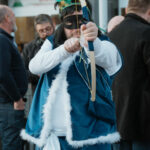
Costume
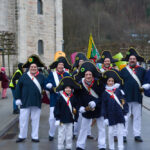
This character or mask wears white trousers, an embroidered blue smock, a red scarf with white polka dots tied with a matchbox, white gloves, a black bicorne hat with a cockade, a sabre slung over his shoulder and a clabot (hand bell). This costume is reminiscent of the French period in our history.
Role
He announces the opening of the carnival to the public on Saturday morning at various locations around the city by ringing his clabot.
Lu Djoupsène
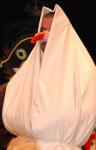
Costume
This character wears white trousers, a white sheet covering the head and arms, which are tied at the waist with a white cord, and a mask with a long hooked nose.
Role
In the past, this outfit allowed the character to steal food from houses. Given the excesses this led to, the mask was banned. Since the 1920s, the Cwarmê has brought back two of them: they always have their hands tied and are forced to walk alongside the Trouv’lê. They only come out on Saturdays.
Lu Vèheû
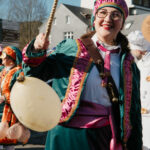

Costume
He wears three-quarter-length velvet trousers decorated with bouillonné, white stockings, a white shirt, a black velvet bow tie, a velvet bolero with long sleeves decorated with bouillonné, a Polish velvet cap decorated with bouillonné and trimmed with bells, a leather shoulder strap with seven bells, and a whip with a pig’s bladder at the end. The ladies wear straight, knee-length velvet skirts decorated with bouillonné.
Role
In the past, an old village custom required young people to hunt the Vèheû (polecat). The polecat would sneak into houses to steal food, pursued by a band of hunters determined to catch it.
Today, the tradition has evolved, with the Vêheû running around incessantly and gently hitting spectators with a pig’s bladder attached to the end of a whip. The hunted animal has become the hunter.
Lu Haguète

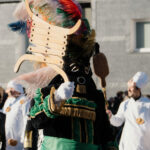
Costume
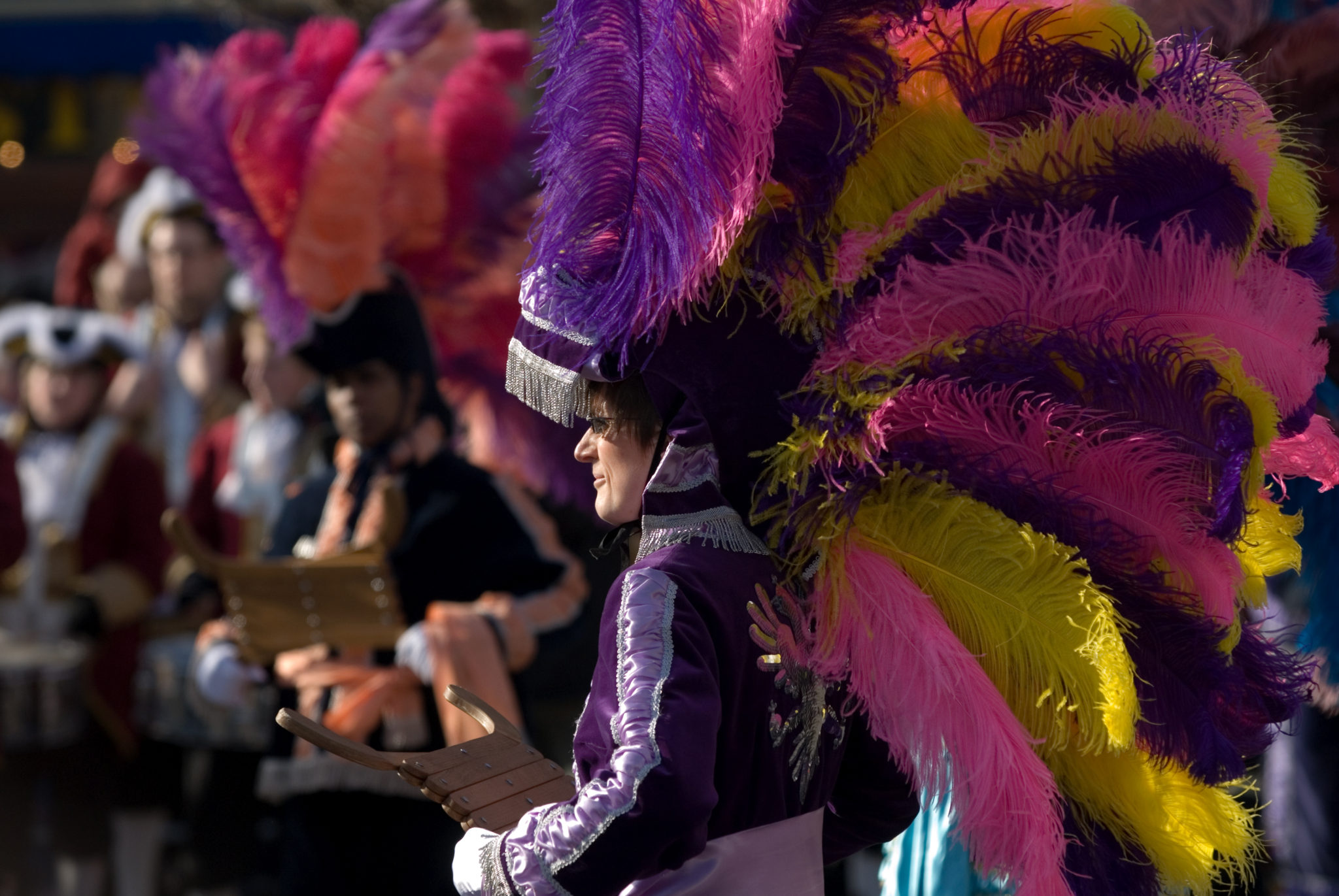
She wears trousers (or a skirt) and a velvet jacket of the same colour, decorated with bouillonné embroidery featuring a double-headed eagle on the back, a gold-fringed satin belt, a bicorne hat topped with colourful ostrich feathers, a fringed hood and a hape-tchâr (a long, wooden meat picker).
Role
Armed with her hape-tchâr (meat picker), the Haguète grabs spectators by the ankle, forces them to kneel and demands ‘forgiveness’ by making the victim repeat ‘Pardon, Haguète, a l’cawe do ramon, dju nu l’frès jamês pus!’: ‘Forgive me, Haguète, I’m disappearing into the chimney smoke and you’ll never see me again!’
Lu Sotê

Costume
He wears white or small checked trousers, a colourful tailcoat with long sleeves containing long arms with white gloved hands, and a huge colourful top hat reaching down to his hips, crowning a mischievous, bearded face located in the middle of his body.
Role
He represents a legendary dwarf who lived in the caves at Bévercé.He hops around incessantly, teasing spectators with his long arms.
Lu Sâvadje-Cayèt
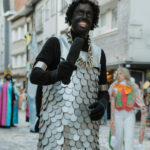
Costume
He wears black tights and undershirt, a coat made of coloured or plain gold or silver cayèts (cayèt = wood chips that fell from the woodcutter’s axe), a black face, black gloves, a black curly wig, a tiara with coloured feathers, necklaces, bracelets and earrings, and a foam club.
Role
The coat is made of cayèts that clatter together with the slightest movement. He is equipped with a foam club and gently messes up the spectators’ hair.
Lu Sâvadje d’Amêrique
Costume
He wears flesh-coloured or white tights and a leotard, a bolero and a short skirt trimmed with white swan feathers, a white fringed satin belt, bracelets and necklaces, ribbons criss-crossed over his calves, a mask (with or without a bib), a smooth black wig, a tiara with coloured feathers, a bow, a quiver and arrows.
Role
The role consists of running with a female spectator, holding her by the hand, then bringing her back to her starting point and greeting her elegantly.
Lu Hârlikin ou Hârlikène

Costume
Hârlikin (male): costume made of multicoloured diamond-patterned fabric or velvet decorated with bouillonné with two points ending in bells; he also wears bells on his wrists and ankles, a white ruff, a triangular belt, a mask (often with a moustache), a black cap, a bicorne-style felt hat, a fox tail and a sabre.
Hârlikène (female): costume consisting of white tights, a white tulle skirt supported by a petticoat, a velvet jacket with two points ending in bells, bells on the wrists, a ruff, a triangular belt, a headdress, a bicorne-style felt hat, a mask and a fox tail.
Role
Mask inspired by the Commedia dell’Arte.
This character tickles the faces of spectators with the fox tail attached to its bicorne hat.
According to ancient custom, Harlequins engage in a duel orchestrated with skilful and graceful gestures for the eyes of a beautiful woman.
Lu Pièrot ou Pièrète
Costume
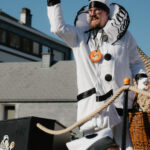
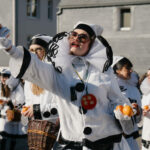
Pierrot: he wears loose white trousers and a loose-fitting white wool jacket decorated with braid and large black buttons, a pointed cap decorated with black buttons, a ruff, a white shoulder bag (for nuts) and a wicker basket (for oranges).
Pièrette: she wears either the same outfit as Pierrot, with the trousers replaced by a wide white wool skirt decorated with braid, or a black tulle ruffled skirt, a short white velvet jacket, a black ruff with white trim, a black round hat and a white wicker basket with black trim.
Rôle
This mask is also inspired by the Commedia dell’Arte.
He distributes nuts and oranges to the audience, who shout ‘Poor Pierrot, who has no money!’ at him « Pôve Pièrot ki n’a pus dès djèyes ! » « Poor Pièrot who has no nuts anymore »
Lu Long-Né
Costume
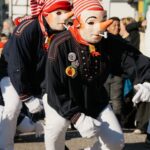
He wears white trousers, an embroidered blue smock, a red scarf with white polka dots tied with a matchbox, a red and white (or blue and white) striped miller’s cap, white gloves, a papier-mâché mask with a long red nose, and a pipe.
Role
In groups of 6 to 8, the Long-Nosed follow each other in single file, choosing a victim to follow and imitate their every move. When the victim has had enough, they take the Long-Nosed to a café and buy them a drink. The person is free to buy them a drink in return.
Lu Longuès-Brèsses

Costume
He or she wears a colourful tailcoat with large buttons, whose elongated sleeves contain long arms, a plain waistcoat, a white shirt, white trousers with the same fabric trim as the tailcoat and large buttons on the outer hem, a white collar, a large bow tie, a small top hat adorned with a peacock feather and a customised hood (or a painted face).
Role
With his long arms, he enjoys messing up the audience’s hair or putting one audience member’s hat on another’s head.
Lu Long-Ramon
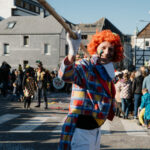
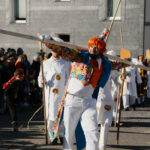

Costume
He wears a colourful tailcoat with large buttons, a plain waistcoat, a white shirt, white trousers with the same fabric trim as the tailcoat and large buttons on the outer hem, a white collar, a large bow tie, a small top hat adorned with a peacock feather, a red wig and a long ramon (a kind of long chimney sweep’s brush with at the end a bouquet of broom).
Role
He walks around feigning indifference and uses his ramon to ruffle the spectators’ hair, knock off their hats or reach the windows on the upper floors to surprise the inhabitants.
Lu Boldjî

Costume
He wears white trousers, a white jacket with a white officer’s collar, a white apron, a white scarf tied around his neck, a white hat, and sewn pretzels (one on his hat, one on his back, one on each shoulder, one on the bib of his apron, and one on each knee of his apron). He has big cheeks, a big belly, and carries a panûle, a bread peel with a long handle.
Role
With his panûle, he “feels” and “weighs” the backsides of female spectators, mischievously comparing them to his batch of bread with phrases in Walloon (such as: bin cût, bin lèvé – well baked, well risen).
Lu Cwapî
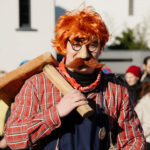
Costume
The Cwapî or shoemaker wears checked or plain trousers, a checked shirt, a blue apron, a red scarf with white dots tied with a matchbox, a big nose with a moustache, a red wig, a stool, a pencil, a notebook, a tape measure, possibly a pair of shoe trees around his neck and a suitcase with shoes.
Role
To play this role, you need to be able to speak Walloon.
They take a member of the audience and sit them on their stool, take their measurements so they can make them new shoes, try the new shoes on the person’s feet and leave them with their new purchase. All this in Walloon, of course.
The masked characters interact with kindness and respect towards spectators, who are invited to participate. Most masks only touch people using an attribute.
Lu Trouv’lê, la Grosse Police and les Djoupsènes are masks reserved for the Royale Malmédienne.
La salade russe
Un seul plat unique qui se prépare à l’avance, voici la maîtresse de maison débarrassée de soucis culinaires pour les jours de fête ! Il se mange froid : seul, entre amis, à n’importe quelle heure du jour et de la nuit et possède la particularité de remettre l’estomac et l’esprit d’aplomb !
Russian salad
A single dish that can be prepared in advance, freeing the hostess from culinary worries on festive days! It is eaten cold: alone, with friends, at any time of the day or night, and has the unique ability to restore both stomach and spirit!
Recipe for 6 herrings
The proportions are quite vague. It’s up to the trained eye to adjust them! And then, you have to keep the recipe a bit of a secret, don’t you?
6 firm herrings, 1 large glass of beetroot (from the garden if possible) in their juice, 1 celeriac, 3 large onions, 1 dish of potatoes, 1 large apple, 6 hard-boiled eggs, 750 g boiled meat, 500 g roast pork, 1 cup oil, 1 glass white onions in vinegar, 1 glass gherkins, a few walnuts if desired.
- Prepare a good vegetable stock (carrots, celery, potatoes, leeks, bouquet garni, etc.).
- Cook the boiled meat until tender.
- Roast the piece of pork in a pan to your liking.
- Cook the peeled potatoes, celery and eggs.
- Leave everything to cool.
- Chop the onions and drained gherkins, the apple, the cooked celery, half the beetroot and the pickled onions from the herrings.
- Crush the walnut kernels.
- Finely dice the two types of meat, the herring (with the bones removed), the other half of the beetroot, the hard-boiled eggs and the potatoes.
- Set aside the slices of hard-boiled egg and beetroot, small onions and gherkins for garnishing the dishes.
- Mix everything together in a bowl, season with salt and pepper to taste.
- Add beetroot juice to achieve the desired colour.
- Leave to rest for one to two days in a cool place, covered with a cloth.
Arrange the Russian salad on plates, garnishing with hard-boiled eggs, onions and gherkins cut in half lengthwise.
This dish can be served with slices of pis (do pé) or andouille (dol landouye), traditional stuffed cow’s tripe.
Enregistrer
Enregistrer
Enregistrer